Bringing home a new puppy is one of life's great joys — and also one of its sneakiest traps. Those first few days of constant cuddles feel wonderful, but every hour your puppy spends glued to your side is quietly teaching them that being alone is abnormal, even dangerous. The good news? If your puppy is between 8 and 16 weeks old, you have a golden window to build genuine confidence and independence before separation distress ever becomes a problem.
Key Takeaways
- The 8–16 week window is the best time to teach a puppy to be alone — before anxious habits form.
- Short, positive alone-time sessions — starting at just 30 seconds — build lasting independence.
- Crate training and a consistent pre-departure routine are your two most powerful prevention tools.
- Avoid "sneaking out" on your puppy; calm, predictable departures reduce anxiety long-term.
- Signs like whining, destructive chewing, or house soiling during alone time are early warnings worth addressing immediately.
Why the 8–16 Week Window Is So Important
Puppies go through a socialization period that closes around 12–16 weeks of age. During this time, their brains are especially plastic — experiences become templates for "normal." A puppy who regularly experiences calm, brief separations during this window learns that being alone is safe and temporary. A puppy who never practices being alone learns the opposite.
This is why so many owners are blindsided by separation anxiety at the 4–6 month mark. Life settles down, the puppy is left alone for the first time — and panic sets in. By then, the pattern is already wired into the puppy's emotional system, making it far harder (though not impossible) to treat. Prevention is simply easier than the cure, and it starts on day one.
Understanding the early signs of separation anxiety in dogs can help you catch any slippage quickly — but the strategies below are designed to make sure those signs never appear in the first place.
Why the 8–16 Week Window Is So Important
🐾 Fun Fact:
The socialization window doesn't slam shut like a door — it gradually closes. Even at 14 weeks, you can still make a significant positive impact on how your puppy handles alone time. Start whenever you are, but start today.
Step 1: Introduce a Safe Space Before You Ever Leave
Before you practice any alone time, your puppy needs a place that already feels good. A crate, pen, or puppy-proofed room becomes the anchor for all your alone-time training. The goal is to associate that space with rest, food, and calm — not with the moment you disappear.
Start by tossing high-value treats into the crate throughout the day with the door open. Feed meals inside it. Let your puppy wander in and out freely. Once they're entering on their own without hesitation, begin closing the door for 10–20 seconds while you stand right there, then open it calmly before any fussing begins. This is the foundation — it has to be solid before you take a single step away.
A well-managed daily routine also makes a huge difference here. Building consistent structure into your puppy's day — predictable feeding times, exercise windows, and nap schedules — makes alone time feel like a natural part of life rather than a shocking disruption.
💡 Tip:
A frozen Kong stuffed with puppy-safe food (plain pumpkin, a little peanut butter without xylitol, or wet puppy food) given only at alone-time practice teaches your puppy that your absence literally tastes great. Keep this treat exclusive — never give it at other times so the association stays strong.
Step 2: Build Alone Time in Tiny Increments
The single biggest mistake new puppy owners make is jumping from zero to thirty minutes of alone time in one leap. Instead, think in seconds first, then minutes. Here is a simple progression:
- Days 1–3: Close the crate door for 30–60 seconds while you sit beside it. Open before any whining starts.
- Days 4–7: Close the door and move to the other side of the room for 1–2 minutes.
- Week 2: Step out of sight briefly — into another room or behind a door — for 2–5 minutes.
- Weeks 3–4: Practice short absences of 10–20 minutes, varying the duration so your puppy can't predict exactly when you'll return.
- Weeks 5–8: Gradually work toward 1–2 hour sessions, always ending before distress peaks.
The rule of thumb: always return before your puppy gets upset. If you're hearing sustained whining or barking, you moved too fast. Drop back a step and rebuild. There's no prize for rushing this.
Step 3: Create a Calm, Consistent Departure Ritual
Dogs are extraordinarily good at reading pre-departure cues — the jingle of keys, the pick-up of a bag, putting on shoes. When these signals reliably predict a long, stressful absence, puppies begin ramping up anxiety before you've even opened the door. You can short-circuit this by deliberately desensitizing those cues.
Pick up your keys and put them down without leaving. Put on your coat, sit on the couch, and watch TV. Walk to the door, touch the handle, and walk back to the kitchen. Do this dozens of times a day until your puppy barely flicks an ear. Now those cues mean nothing in particular — and your actual departures become far less dramatic.
When you do leave for real, keep goodbyes brief and cheerful but low-key. A warm "be right back!" is fine. A five-minute guilt-fueled farewell ritual amplifies your puppy's arousal and makes the transition harder. Return just as calmly — wait until your puppy has four paws on the floor before offering any greeting.
🧠 Think About:
Many owners assume that a long walk before alone time will tire a puppy out and make them sleep. Exercise does help, but mental enrichment — a sniff-heavy outing, a puzzle feeder, or a short training session — often calms a puppy's brain more effectively than physical activity alone. Try combining both for best results.
Step 4: Avoid These Common Mistakes That Accidentally Create Anxiety
Even well-meaning owners can accidentally work against themselves. Here are the habits most likely to undermine your alone-time training:
- Sneaking out: It feels kinder, but leaving without warning makes absences unpredictable and scary. A calm, consistent goodbye is always better.
- Rushing back when your puppy cries: Returning while your puppy is whining rewards the whining. Wait for even a two-second pause before re-entering, then praise and reward that quiet moment.
- Too much constant contact: Carrying your puppy everywhere or never putting them down prevents them from developing any self-soothing ability. Schedule deliberate "floor time" and "settle practice" every day.
- Skipping the protocol on "easy" days: Consistency builds the neural pathway. If alone-time practice only happens when you feel like it, the learning doesn't consolidate.
- Using alone time as punishment: Never crate or isolate your puppy after a scolding. The safe space must stay emotionally positive at all times.
📌 Tip:
If your puppy drools excessively, refuses to eat the Kong they normally love, or shows frantic escape attempts during practice sessions, these are signs of real distress — not just protest. Slow right down, make sessions shorter, and consider reaching out to a professional for guidance sooner rather than later.
How to Read Your Puppy's Progress
Not all whining signals anxiety. Puppies communicate in a noisy spectrum — a few quiet protests when the crate door first closes are normal and usually self-resolve within 1–2 minutes. What you're watching for is the quality and trajectory of the distress, not a single incident.
Good signs your protocol is working:
- Your puppy voluntarily enters their safe space without being lured.
- Whining, if it occurs, stops within 60–90 seconds and doesn't escalate.
- Your puppy is asleep — or working on their Kong — within a few minutes of you leaving.
- Greetings when you return are enthusiastic but not frantic or prolonged.
Signs you may need to slow down or seek support:
- Sustained, escalating vocalizations lasting more than 2–3 minutes.
- Refusal to eat high-value food once the door closes.
- Destruction focused on exit points (door frames, crate bars).
- House soiling only when alone, even when recently taken out.
Breed and individual temperament play a real role here. Border Collies, Vizslas, and German Shepherds tend to bond intensely and may need extra patience with this protocol. Basset Hounds or Shih Tzus may settle more readily. Meet your individual puppy where they are.
How Can PawChamp Help?
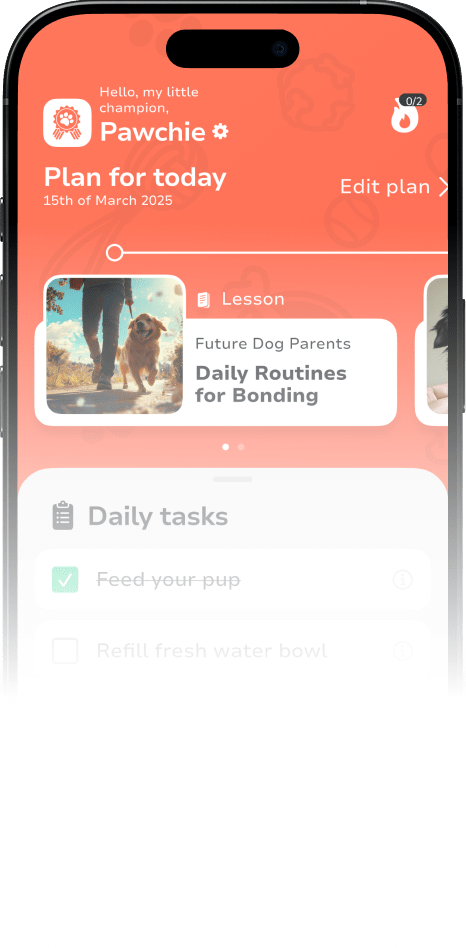
PawChamp is built specifically to support you through exactly this kind of foundational training — the kind that prevents problems before they need to be fixed.
- Personalized training plan: Answer a few questions about your puppy's age, breed, and temperament and PawChamp generates a step-by-step alone-time protocol matched to where your puppy actually is — not a generic one-size-fits-all schedule.
- Expert-verified lessons: Every lesson on separation prevention is reviewed by certified professionals, so you can trust the advice is humane, science-based, and up to date.
- In-app expert chat: Unsure whether what you're seeing is normal protest or early anxiety? Chat directly with a Dog Training Expert or Dog Health and Care Expert inside the app and get a real, personalized answer — without waiting for a vet appointment.
Whether you're on day one with a brand-new 8-week-old or realizing you need to course-correct at 14 weeks, PawChamp walks you through every step so nothing falls through the cracks.
Bottom Line
Teaching your puppy to be alone is not about leaving them to figure it out — it is about building the experience of safety so gradually that being alone becomes genuinely unremarkable to them. Start in the first week home, keep sessions shorter than your puppy's tolerance, and stay consistent even on the days it feels unnecessary. The few minutes you invest in this protocol now will save you — and your dog — from months of stress later.